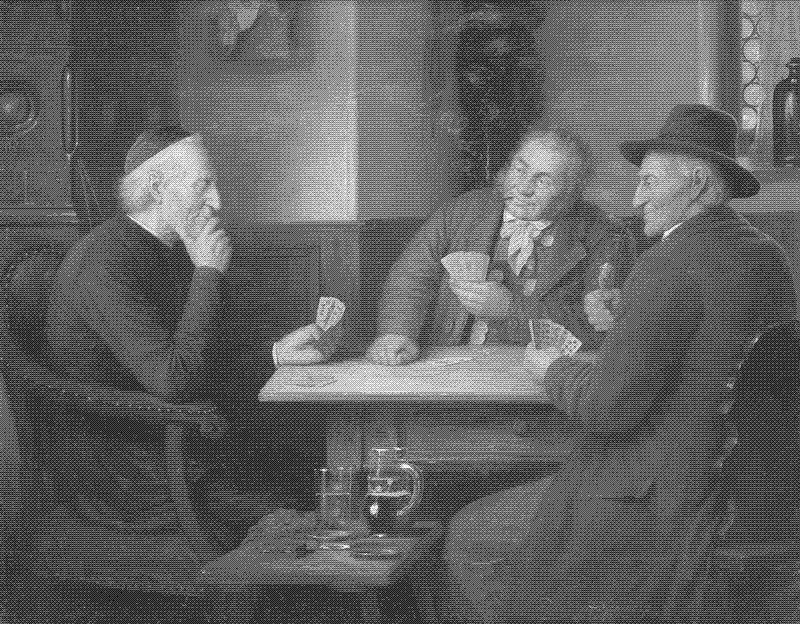

Doppelkopf (IPA: /ˈdɔpəlˌkɔpf/, EN: ‘Double-Head’) is a German 4
player trick-taking card game which you can play using two standard decks of cards.
It’s a 2 vs. 2 player game, where one team is formed by the two players holding the Queens of Clubs (meaning that partnership is secret at the start of the game).
What if one player holds both Queens of Clubs? Why, they get to play a solo, or they get to announce a ‘wedding’, which results in a prisoner’s dilemma auction to determine who becomes their partner (if anyone). This sounds complicated, but is actually incredibly funny.
It is the best card game I ever played. Better than Uno, Oh Hell, Rummy, Cuttle, Schnapsen, Poker, Sheepshead, even Skat or Bridge1. The jury is still out on whether it’s better than 找朋友.
You might ask “Why would anyone in their right mind learn how to play an obscure German two hundred year old card game? One that requires exactly four players, no less?”
Because it’s good.
The social component is delightful. The meta-scoring is great, if you are into that (you gather ‘meta-points’ across games, and benefit from raising the stakes to increase your payout). It’s whimsical (players may announce “half a chicken”, which does nothing other than give other players free information about your hand), and there’s a real difficulty of tracking the cards that have been played, and which the other players are holding.
You might not have the right people in your life to play Doppelkopf with, but your life would almost certainly improve if you did.
To get there, maybe consider taking the first step, and being the person who shows up strapped with a deck of cards to the local function. Doppelkopf or otherwise, you should learn how to play card games that are actually fun.
Teaching Doppelkopf is, unfortunately, a bit tricky. It’s best taught in person. In this post, I will teach you how to play general trick-taking games like Bridge, Doppelkopf, or Skat.
Trick-taking is the core gameplay loop. Once you understand trick-taking, the rest is meta progression and fluff.
In ‘How my friends and I play Doppelkopf’ I explain how my friends and I actually play Doppelkopf. In the meantime, if you strictly want to learn Doppelkopf, I recommend Ham Vocke’s project Doppelkopf.club. Ham is a programmer, presumably even more passionate about the game than I am, and Doppelkopf.club allows you to play against bots online.
Trick-Taking
Doppelkopf is a trick-taking game. This distinguishes it from shedding games (such as Uno). In shedding games, your goal is to shed all of your cards onto the discard pile.
In trick-taking games, your goal is to score points by winning as many “tricks” as possible.
A “trick” consists of a single round along the table. Each player puts down exactly one card (in order), following the suit of the first player, if they are able to. The highest-ranking card wins.
The winning player then “takes” the cards and puts them face-down on their side of the table. They then open the next trick.
How do you determine which card wins? Basically, the highest-ranking card is the highest-ranking trump (if a trump was played), and otherwise the highest-ranking card of the first player’s suit.
By the way: The phrase “to follow suit” has its origin in card games. In all trick-taking games you “follow suit”, and the suit changes every trick.
What if the first player opens with a trump card? Then everyone has to follow with trump, if they can. The right way to think of trumps is as “belonging to their own suit”.
Doppelkopf has a lot of trumps, including all Queens and Jacks. As an example: If you have a 10 of Spades and a Jack of Spades and the first player opens with Spades, you are not allowed to play the Jack of Spades. Why not? Because it’s part of the trump suit. It doesn’t count as Spades.
(Yes, that part is important, but also confusing.)
Example
Player A opens the trick. They get to play any card they want. They play a King of Clubs.
Player B has clubs, so they have to play clubs. They play a 9 of Clubs. This card ranks lower than the King of Clubs.
Player C does not have any clubs. Therefore, they get to play a different suit. (This may be good or bad for them.) They play a 10 of Spades. This card is not a trump, and not a Club, so (in this trick!) it also ranks lower than the King of Clubs.
Player D does not have any clubs. Therefore, they get to play a different suit. They play a Jack of Diamonds. In Doppelkopf and Skat all jacks are trump. Therefore, the Jack of Diamonds ranks higher than the King of Clubs, and Player D wins this trick.
This is the core gameplay loop of many different games. This is most of what you need to understand.
After every player played a card, the winning player (D, in our example) claims them. They all contribute to their score at the end of the game.
Finally: The winner of the trick (D) is the person who gets to play the first card of the next trick. This loop repeats until everyone is out of cards.
That’s it! That’s the whole game.
“Every” trick-taking game follows exactly this format, with minor variations (such as which cards are trump, and how tricks are scored at the end of the game).
Why is this a good core gameplay loop?
Each time you play a card, you are gambling on which cards the other players have. However, as the game goes on, because players are required to follow suit, you are obtaining a lot of information about their hands.
Through this the game rewards tracking which cards have been played, and which players are out of which suits. This then allows you to gauge whether you can safely win a trick or not.
This will take some time to develop a feeling for.
For the record: I don’t count cards! I do it by feelings and vibes. You can probably beat me!
In Doppelkopf specifically, the hidden partnership makes this even more engaging. If you are winning a trick, you want your partner to “throw in points”2, such that your team can secure them.
Here is a common tactic: At the very start of the game (if you’re leading), play an Ace of Spades. If every player has a Spade (reasonably likely), you win this trick by default, since the Ace of Spades is the highest Spade, and none of them can play a trump. This is fairly safe, and earns you a good amount of points.
There’s just one problem: At the start of the game team membership is unknown, so your partner is not going to throw in any points. This is a tradeoff.
This is good game design.
What’s left?
Once you understand trick-taking, it will be easy for you to pick up any trick-taking game. That includes Bridge or Skat or 找朋友. (Or Oh Hell!, but it’s not very good.)
Now, the next part is where trick-taking games differ.
First, trick-taking games disagree on which cards are trump (or more generally, on which cards “beat” which other cards).
Second, trick-taking games disagree on how tricks are scored at the end of the game (i.e. how do you determine who wins).
Third, trick-taking games disagree on the meta-scoring, i.e. on how points are counted across multiple games. This is only relevant if you repeatedly play with the same group of people.
Each game will have slightly different opinions on each of these, on top of its own little quirks and oddities3.
Bidding
Finally, most trick-taking games have some sort of bidding process. Bidding happens after cards are dealt, but before trick taking starts. During bidding, the players estimate how good their hand is, and then compete for getting to play.
(In Skat and Bridge, this is how the “attacker” is determined. In Doppelkopf, this is where solo games are declared.)
The bidding process is completely inscrutable to new players, and widely considered to be the hardest part of the game. You need to be able to estimate how good your odds of winning are before you have even played the game. Your “bid” will allow you to choose which cards are trump, and influences how many meta-points you win (or lose!) at the end of the game.
Content Warning: A Skat Reiztabelle
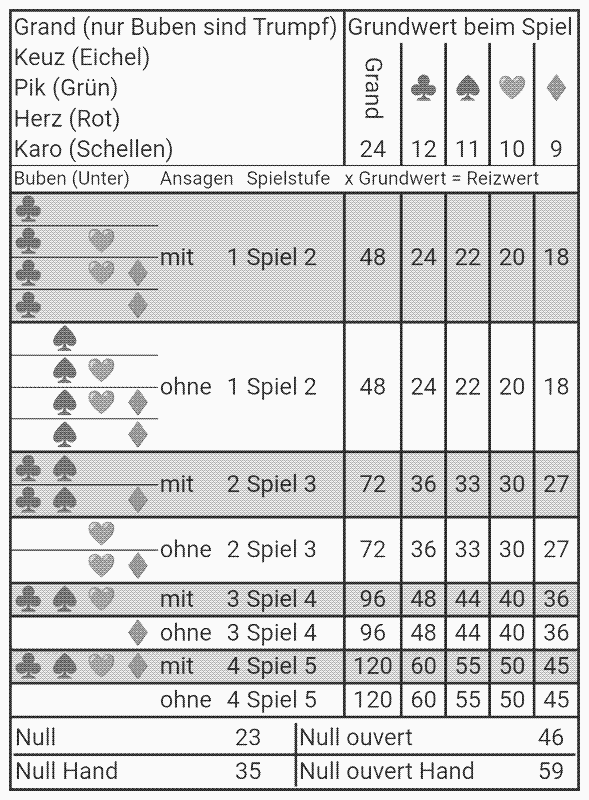
You might be laughing nervously, but the chart follows a predictable pattern. It’s not as bad as it looks.
tl;dr: Count how many consecutive jacks you have (or how many empty consecutive slots you have) starting from the first. Then, you add +1, and multiply the result with a ‘base value’ for the suit (or 24 for the ‘grand game’ which has no trumps other than Jacks).
Still, it’s intimidating!
If my case for trick-taking games was remotely compelling, and you’re now looking to learn a new card game, heed the following advice:
Ignore the bidding and meta-scoring completely.
The bidding phase is the hardest part of the game. While learning, just rotate who attacks. Play default games. Make the obvious decisions. It’s much, much easier that way. Bidding is the meta-game on top of the game. Think about it once you’ve played a few rounds without it.
Then, go slowly: Many of these games have fancy rules for special types of sub-games (null games, playing with open hands, meatless solo games, Ramsch, etc.), most of which you should ignore until curiosity wins out.
Conclusion
Go and pick up a deck of cards. Carry it with you. There’s no aura loss. You can play dozens of games with it.
Whip it out over coffee with your friends.
Schnapsen is weird, but only requires two players. Skat requires three. Bridge and Doppelkopf require four. Sheepshead is for five. 找朋友 is… crazy and can be played with arbitrary larger groups, I think?
Go and have fun!
If you've made it this far, consider signing up for e-mail notifications, following along on Substack, or adding this blog to your RSS reader.
-
If, at this point, you’re wondering if I am talking about the same Bridge you most likely associate with retirement homes, then yes, I am! The boomers are absolutely right about Bridge being a great game. ↩︎
-
This is different from Bridge, where you just count the number of won tricks. In Doppelkopf, some tricks score more points than others. ↩︎
-
Bridge, for example, has what we lovingly call ’the cuck chair’. It’s a four player game, but each round one of the players has to watch. It’s unclear to me why anyone would think that is a good idea. ↩︎