
Alright, get it twisted, if you are for whatever reason reading this post without having read You should learn to play Doppelkopf, then you should rectify that immediately. This here is a follow-up that goes into the rules my friends and I play by. Each table has their own house rules (and that’s a good thing).
This post will not teach you how trick-taking works. You should already understand trick-taking going into this! If you don’t, it’s going to be confusing.
As in the last post:
Doppelkopf (IPA: /ˈdɔpəlˌkɔpf/, EN: ‘Double-Head’) is a German
four-player trick-taking card game. Each card appears twice. Two players vs. two players (usually), with
one team formed by the two players holding the Queens of Clubs.
It also has a whole pile of bonus rules and complexity.
In the following, I’ll go over the core rules that you need to play the game. I will try to introduce them in a way that makes sense. On the side, I will comment on the rules.
If you ever think “Jeez, this Mond fellow is doing an awful job, this is so confusing,” please trust me when I say that most Doppelkopf tutorials online are worse.
Card games are best learned in person.
If you don’t have anyone who can teach you, Doppelkopf.club might be your best bet. Owned by an enthusiast, no sign-ups or other nonsense.
Outline
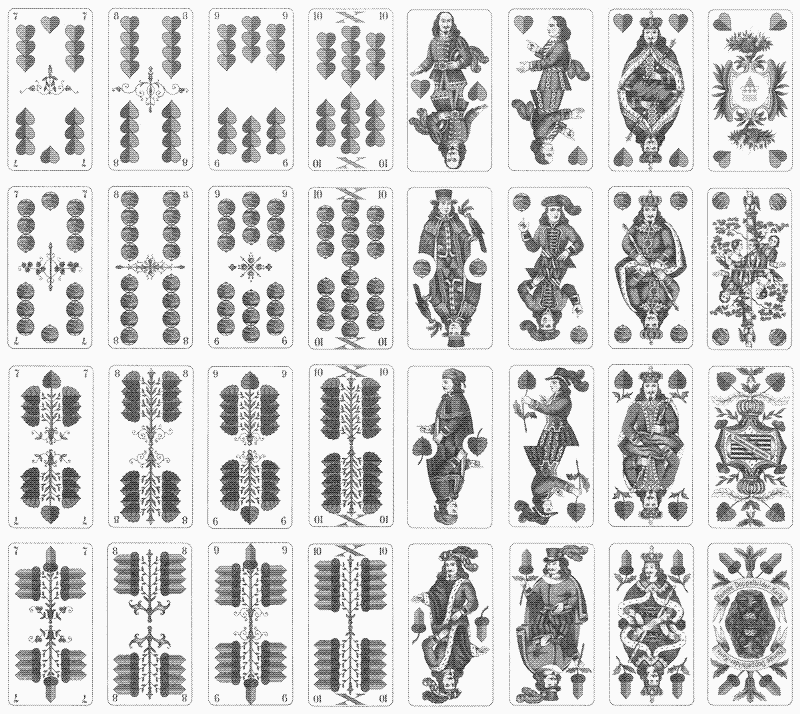

In Doppelkopf all cards are dealt at the start of the game (this is normal for trick-taking games). To assemble a Doppelkopf deck, take two “standard” French decks of cards. Remove all number cards of value 8 or lower, and all jokers. That’s a Doppelkopf deck. Don’t play with German-suited cards, just use the French ones.
Every player gets 12 cards, and unless a player has reservations, you are ready to start playing. No cards are ever drawn, so the game consists of exactly 12 tricks1.
The outline of the game is the following:
- Gather 4 players. Shuffle the deck, and hand every player 12 cards. No cards should be left.
- Each player looks at their hand and decides whether they have “reservations” or they are “healthy”. This part you should completely ignore until you’ve played several normal rounds. “Reservations” are special conditions that depend on your hand and that alter how the game is played.
- The person to the left of the dealer plays a card, opening the first trick. The other players follow suit in order. The winner of the trick opens the next one.
- Team membership is determined by whether you have a Queen of Clubs or not. The two players holding the Queens of Clubs are the ‘Re’ team. The other two players are the ‘Kontra’ team. You do not know who is on which team until the Queens of Clubs have been played.
- After all 12 tricks have been played, each team scores all tricks they won.
- There are 240 points total. The team with more points wins. If it’s 120:120, the Kontra team wins.
- If you’re so inclined, you can keep track of ‘meta-points’ across multiple games. This only makes sense if you play regularly.
This makes it reasonably simple. Once you know the rules, you just hand out the cards, and can immediately start playing. Announcing reservations is a form of bidding (i.e. you have the option to make the game harder for yourself, in return for more meta-points), but I recommend that you just ignore that completely.
Are we bad at the game? Yes, probably.
Are we having fun? Also yes.
This is one of my pet drums, so forgive me for beating it: Social games like Doppelkopf are made to be fun. The play at our table is almost certainly not optimal, and other Doppelkopf players would probably disagree with our house rules.
We like that it’s possible to just hand everyone 12 cards and jump straight into a game, without having to worry about cross-game scoring, or every player having to spend time evaluating how good their hand is. Other groups may disagree.
The Game
Once all cards are dealt, and players have announced whether they have any reservations, the trick-taking phase of the game starts.
At this point, bless our stupid, whimsical hearts, my local group of players will start hollering and shouting all sorts of obscenities, and use language that’s decidedly non-standard.
For example, ‘playing a Queen of Clubs’ reveals which team you are on.
Consequently, my local group frequently dubs this act ‘coming out’. You can imagine how this would easily lead to a ‘gay’ and a ‘straight’ team, and we are using this terminology with nothing but whimsy and fondness in our hearts.
Anyway.
Let’s cover the numbers. As I said in my previous post, trick-taking games usually differ on 1) card ranking and trumps, 2) card scoring to determine the winner, 3) meta-points (i.e. how points are scored across games).
You may hate what comes next. Doppelkopf is a European game. Worse, it’s German. As such, the scoring is ever so slightly more complex than it needs to be. (But trust me, it’s not nearly the worst of the bunch, and there are good reasons for it.)
Before we start, internalize that:
- Whether a card “beats” another card is unrelated to the points the card scores at the end of the game.
- The points you score throughout the game are not the same as the meta-points you score between games. The game points determine whether you win the game. Meta-points are tracked separately, across games, to determine who wins across a season of Doppelkopf.
Card Ranking
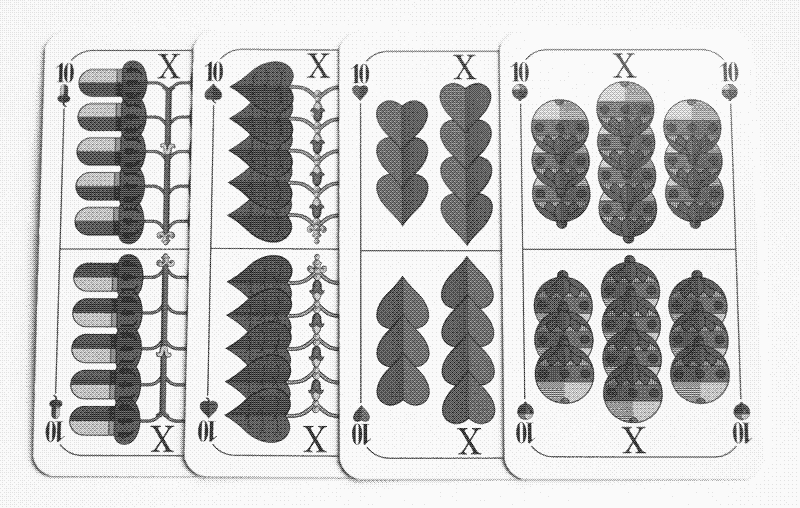
In Doppelkopf (and Skat) Tens are ranked higher than Kings.
So the order of, say, Spades, comes out to: Ace, Ten, King, and Nine.
Next, let’s talk about trumps.
Doppelkopf is a game with a lot of trumps. In fact, most of the cards are trump (this is funny, and part of what makes the game unique). The order of the trumps (high to low) is as follows:
- Ten of Hearts (‘Dulle’).
- All Queens, in order Clubs, Spades, Hearts, Diamonds.
- All Jacks, in order Clubs, Spades, Hearts, Diamonds.
- All remaining Diamonds (
Ace, Ten, King, Nine).
20’s Love. We love the Ladies. Jackin’ off. Diamonds are Unbreakable. No Kings2.
That’s how my friend remembers the order, anyway. At the start of the game I recommend sorting trumps separately, to make it easier to keep track of them.
And yes, the Ten of Hearts and the Diamonds are “special”, in a sense.
These are the trumps.
This order is strict, i.e. any high trump beats any low trump. If we both play Jacks, the higher Jack wins. If we both play the same Jack, the first card beats the second3. This is true whether you’re playing the trump suit or a different suit. Of course, trumps always beat non-trumps.
Scoring
At the end of the game, look at all cards your team won. Then, add up the points according to the following list:
- Ace: Worth 11 points
- Ten: Worth 10 points
- King: Worth 4 points
- Queen: Worth 3 points
- Jack: Worth 2 points
- Nine: Worth no points
In other words, Aces and Tens are valuable. Try to capture them. That’s how you win.
In total, there are 240 = 2*4*(11+10+4+3+2) points. You win with 121 points. On a tie, the
Kontra team wins. Often you just count the points of the team that obviously won fewer tricks.
This sounds horribly annoying, but it’s really not that bad. Counting happens quite quickly once you’ve done it a few times.
This is all you need to know to play the basic game of Doppelkopf.
At this point, I would recommend doing exactly that, if you have someone to play with. What follows next is rules for what happens when someone is dealt both Queens of Clubs, special cases, house rules, and meta-scoring.
Reservations & Weddings
I’ll talk about the types of reservations we care about in my small, local group.
Half a Chicken
The most important reservation of all. If you hold the two Tens of Diamonds, you may announce half a chicken.
Announcing half a chicken does absolutely nothing, but a true gentleman should do it regardless.
When new players are introduced, it’s critical to haze them about not knowing what ‘half a chicken’ is.
Schweinchen / Swine / Piglets
If you hold the two Aces of Diamonds, you may announce Schweinchen.
Announcing Schweinchen makes the Aces of Diamonds the highest-ranking trumps in the game. They become a new tier above the ‘Dullen’ (the Tens of Hearts).
This is not balanced, and frankly, probably a bad rule. However, it is pretty funny, especially if you allow Double Swine (two Nines of Diamonds) and Triple Swine (two Tens of Diamonds), which may be announced by other players, and have to be announced in order. In other words, if you announce Swine, there is a risk that another player may announce Double Swine, making their trumps even stronger than yours.
This is firmly in the category of house rules. House rules are part of what makes these games good. We’re still inventing our own.
Weddings
It’s possible that one player ends up holding both Queens of Clubs, making them their own partner. They have three options:
- Play a ‘silent solo’. No announcements, they just secretly play a solo against the other players. This is difficult, but the other players may be confused, giving them an advantage.
- Play a loud solo. They announce that they are going to play a solo game. This triples their meta-points, but is much harder.
- Announce a wedding. This is the default, and allows them to find a new partner.
When a wedding is announced, the new partner is chosen as follows: The first player (other than the Re player, i.e. the player holding the two Queens of Clubs) to win a trick during the first three tricks becomes the new partner.
If, however, no one else wins a trick, then the Re player is forced to play a solo.
In other words, the other three players get the opportunity to deny the Re player by consistently making them win their first three tricks.
However, each of the other players has an incentive to be this person’s partner. The two Queens of Clubs are strong trumps, and the Re player may already have won one or two tricks. The players may backstab each other to ‘marry’ the Re player.
Tradeoffs!
Everything up to this point has been ‘Doppelkopf-lite’, i.e. the version with no meta-scoring across games.
Meta scoring doesn’t really matter unless you have a group you consistently play Doppelkopf with.
If you really insist, Solos
During the bidding / reservations phase, you are allowed to announce a solo.
Solos are hard, so it’s only worth it if you have a strong hand. In the meta-scoring system, winning a solo nets you thrice as many points. Here are the solos you are allowed to announce:
- Jack solo: Only Jacks are trump.
- Queen solo: Only Queens are trump.
- “Meatless” solo: No trumps exist.
- Suit solo: Tens of Hearts, Queens, Jacks, and a suit of your choice are trump. A Diamond solo has the same trumps as the normal game.
Scoring across Games

My local group doesn’t score points across games. I could take it upon myself to push them on it, but I’ve won a good number of games so far. Tracking a list of my own victories would not improve the experience.
Besides, we try a lot of different games. Doppelkopf has been the best one so far, but it’s hard to tell if we’ll truly stick with it over, say, other card games, TTRPGs, or what have you.
What I’m saying is, sorry, I don’t actually do the meta scoring as often as a True Doppelkopf player should!
Let me do my best at explaining the scoring. I can give you the fundamentals, but you should look it up if you want to take this seriously.
The rough idea of scoring is that Doppelkopf is zero sum. The winning party gains points, the losing party loses them. Therefore, if you win a solo, you’ll get thrice as many points. That makes solos worthwhile, even though your odds of winning are dramatically lower.
You start with one point for a won game. If the Kontra party won, you add another point. Then, you get an additional point for each 30 points you are above 121.
Taunting
You get to taunt. The first taunt pre-announces that you expect to win. After that you pre-announce that the enemy team will receive fewer than X points.
en the official rules, you taunt by announcing “Re” or “Kontra” (depending on team). This raises the stakes by two points. Any enemy may counter, raising the stakes by another two.
Announcing “No 90”, “No 60”, “No 30”, or “Schwarz” raises the stakes by one point each, but also requires you to meet that bar. This means: You have to beat the opposing team, and they MUST have fewer than X points (or in case of Schwarz, win zero tricks). If you fail to achieve this, you lose the round.
Taunting is an incredible mechanic. If you are confident, this increases your payout. If you are too confident, you will lose a lot more points than you otherwise would have.
Taunting is only allowed early in the game, otherwise you’d just do it when you already know that you are going to win. “re/kontra” must be called while you’re still holding 11 cards. No 90 requires 10 cards, No 60 requires 9, etc. After you taunt, the opposing team always gets at least one more turn to respond.
What I hate about taunting
Taunting allows you to announce your team affiliation.
This is morally wrong: The best part about Doppelkopf is that team affiliation is unknown, and only revealed when you play a Queen of Clubs.
Calling Re or Kontra raises the stakes, so it has consequences on the game, but it still feels wrong to me. Ideally, you should be able to announce “my team is going to win” without declaring the name of the team.
Of course, the problem is that (ideally) the opposing team responds by taunting back. Here this seems unlikely, since they don’t even know whether they are on your side or not!
I am still trying to figure out if there is a way to resolve the conflict, or if it is a problem at all. If you have strong opinions on this, send me an e-mail. Currently I understand the rules as follows:
- If you track meta-points, you can taunt. Taunting announces your team membership, but it requires you to raise the stakes. You cannot announce membership otherwise.
- If you are not tracking meta-points, you are not allowed to taunt (or announce team membership).
Bonus Points
In Doppelkopf, we love our bonus rules.
- If you capture the enemy team’s fox (i.e. their Ace of Diamonds), the stakes are raised by another point. This can happen multiple times if the opposing team has both Aces of Diamonds.
- If you win a so-called “Doppelkopf” (40+ points in one trick), that’s another point.
- If you win the last trick of the game with the Jack of Clubs, that’s another point.
Conclusion
My local Doppelkopf group finds the game, and its pile of whimsical bonus rules, incredibly entertaining, but yes, that’s all just us being weird.
I’d like more people to give these games a try (Doppelkopf, or Bridge if necessary). They are better than you’d think. They are social. Fun. Different. And it’s so easy to carry a deck of cards with you at all times.
In my friend group we “stay strapped” (carry decks of cards at all times).
Are you worried about an increasingly atomized society?
Or the loss of third places after skimming ‘Bowling Alone’?
Carry a deck of cards.
Go grab coffee with your friends, then social-mog everyone by whipping it out and playing.
Grab two or three friends and dress up nicely, go to a nearby jazz club, then invite strangers to play4.
Be the change you want to see in the world.
If you've made it this far, consider signing up for e-mail notifications, following along on Substack, or adding this blog to your RSS reader.
-
This is part of what makes these games work! Because no one ever draws new cards, you can learn when someone is “out of hearts”, and there’s no risk they’ll just draw a new heart. ↩︎
-
Other than the King of Diamonds. ↩︎
-
The best Doppelkopf includes plenty of house rules, and here we have one important exception: The second Ten of Hearts beats the first. This ‘balances’ the strongest trump in the game, and requires more tactical play. This house rule is then balanced out with another: The second Ten of Hearts beats the first except on the final trick of the game, ensuring people are careful about holding on to their card. ↩︎
-
This is on our to-do list. ↩︎