‘Pizza Delivery’ is a masterclass in humor. As far as 90s-era undersea Italian-dish slapstick goes, it is the clear pinnacle of the genre. Even IMDb agrees, putting it as the 7th best Spongebob episode of all time1.
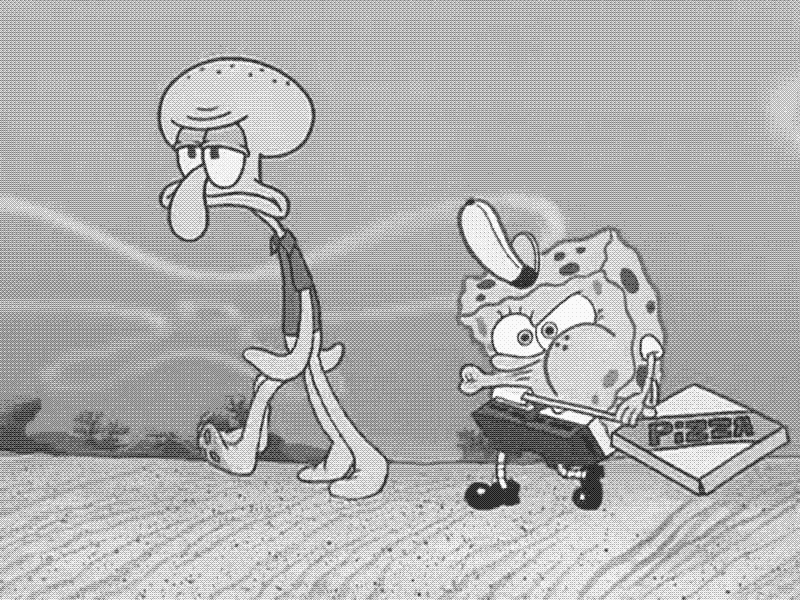
Pizza Delivery
In Pizza Delivery, our heroes Spongebob and Squidward are asked to deliver a pizza. They end up stuck in the wilderness without a car, and struggle to find their way back to civilization.
Every single beat in the story exists to explore the contrast between Squidward’s cynicism and Spongebob’s naive cheer. Neither of the characters is “the joke character”, and neither of them would even have gotten themselves “in a situation like this” without the other’s involvement.
This is to say, Spongebob is happy wandering the wilderness. He’s fine, and would manage to return to civilization on his own. He’s “the fool”, he’s too naive and too cheerful to be harmed.
Squidward on the other hand. If he were on his own, Squidward would never have gotten into this situation in the first place, and even if he had, he’d “just leave” and abandon the mission with an “I don’t get paid enough for this” attitude (as seen by him wanting to eat the pizza as he gets hungry, while Spongebob insists on preserving it for the customer). He’s cynical.
Neither Spongebob nor Squidward is a “joke character”. Rather, the story is an exploration of what happens when characters with different attitudes towards life are working together.
Flanderization
Flanderization is what happens when (across the seasons) characters in TV shows become “flat” and are phased out in favor of skinwalkers trying too hard not to break character.
It’s what happens when you have “the smart character” and “the funny character”, and the writers start taking shortcuts, and view and write their characters fully in terms of these stereotypes. The character stops having nuance, and turns into a pastiche with the word “SMART” or “FUNNY” written onto it in bold red letters.
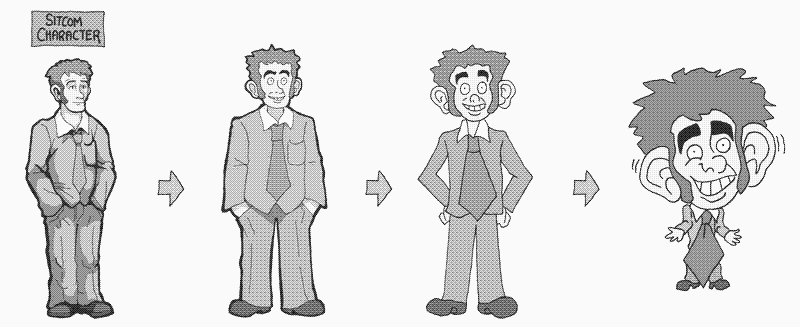

(Basically ~everyone agrees that this is bad. Explaining how it happens is a different question.)
If you set out to write a “joke character”, or even just a “funny character”, at worst you are flanderizing your character before they ever even got a chance to live and breathe.
You are outsourcing “funniness” to a dedicated cardboard cutout that you drag onto the stage whenever you need a joke-shaped digression (to lighten the mood, fill the space, transition from one scene to another, or knock over a vase to kick off a story, because you could not think of a more natural way to get there). That’s bad.
In Pizza Delivery, the humor exists in the interaction of two characters, neither of whom is particularly funny on their own. This is not a high bar! No, seriously!
You may say “Oh, who cares! Just let people have fun! Look, I have seen ‘family guy funny moments compilation’ in your algorithm history, stop acting like you are better than us you art snob.”
Fine, fine, but now look at this from the angle of trying to write a funny story.
The comic relief character hurts your story because it is predictable. Humor benefits from unpredictability and novelty.
The worst funny characters are always the same. They make the same themed puns, or act “stupidly”. None of their interactions depend on whom they interact with, and so every joke is predictable.
The best characters have novel interactions with everyone and everything they encounter. Funniness arises as an intersection of their unique traits, and the novelty of what they are interacting with.
If I show you “the stupid character” walking into a laboratory of expensive equipment where “the smart character” is working, you can see the joke coming from miles away. Boring!
Against Against Funny Characters
Okay, but seriously, comedy has no hard rules + playing at the very boundary of what’s allowed is also part of comedy.
This is to say, if I say “DO NOT WRITE FUNNY CHARACTERS >:(” and this were to become a universal rule, then playing with what a “funny character” is, or explicitly putting them into media would in itself become more funny. You are doing a thing that you shouldn’t do, intentionally, for the bit.
At this point the meta-commentary itself becomes the joke. This is different from what I am objecting to, which is lazy/thoughtless supposedly funny gag characters, especially in media that doesn’t require them.
Likewise, “character studies” of a character that’s meant to be silly (in some form or another) are fine.
tl;dr: writing rules are meant to be broken, and in comedy specifically, subverting expectations by making a joke that should not be made is a common pattern.
See the Family Guy chicken. It’s not exactly a joke character. The running gag is that a human-sized anthropomorphic chicken shows up to interrupt an ongoing scene, and he and Peter Griffin start beating the crap out of each other.
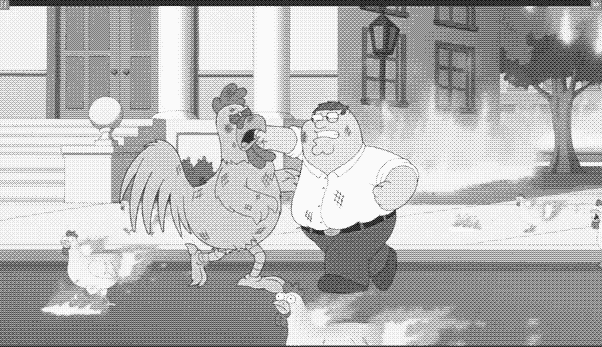
This is humor on multiple levels:
- It is completely unexpected. You were tricked into caring about something else, and suddenly, bam, all that gets thrown out.
- It requires the creation of complex, hard-to-animate fight sequences. i.e. it’s not cheap, it’s more expensive and difficult to produce.
- It becomes a running gag which is then referenced and subverted later.
Yes, this is disgustingly meta, and meta is easy, but it still manages to be funny.
Hades
Hades is an award-winning video game by beloved studio Supergiant Games, previously known for shorter, linear and story-heavy experiences such as Bastion, Transistor and Pyre.
Hades is an “action roguelite with a story”, which is to say, it’s segmented into individual thirty-minute “runs”. After each run you enter the hub area, where waiting characters may have a few new crumbs of dialogue2.
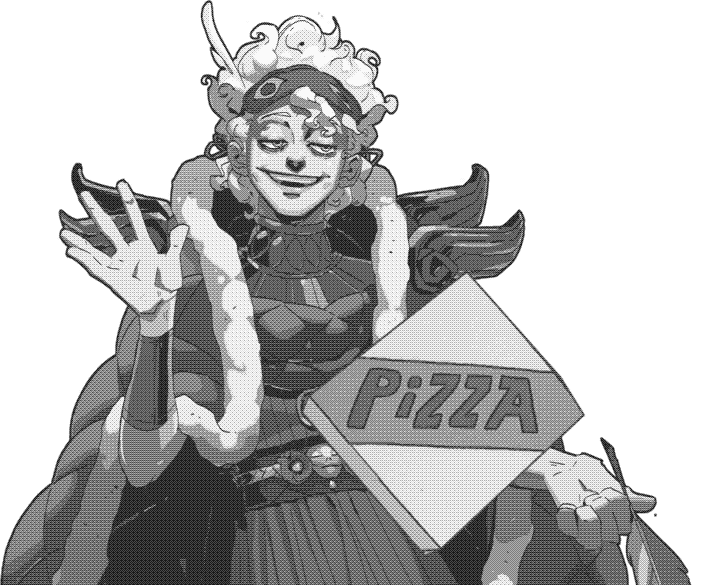
Hypnos is a joke character. Hypnos’ “bit” is to deliver a single funny one-liner every single time your main character returns to the hub area of the game (usually after a death, which Hypnos will comment on). As an example:
“So you got skewered by a Spike Trap out there, huh? Well, that’s too bad! Have you tried not standing there, like, when the spikes come out?”
I hope you agree that this is bad dialogue, but you have to understand that Hypnos has well over forty fully voice-acted lines, and that all of them are exactly like this.
This is all Hypnos is. Characters like him hurt my immersion to a degree that’s hard to overstate. It’s writers contorting themselves to add a joke where no joke was required3.
He’s not a character, he’s uh, a lamp fixture. A piece of furniture. I suspect that the reason he exists is just to make the main hub area feel less empty.
Whimsy
At this point you, dear reader, are almost certainly convinced that I’m the least fun, least whimsical person alive, but nothing could be further from the truth.
I brim with whimsy, to the point that it’s to my own detriment.
The fear and loathing I have towards “funny” characters is downstream of the horrifying thought that, as we become older, more comfortable, more entrenched in our ways, all of us flanderize and turn into caricatures.
I don’t like this thought.
I don’t want to be seen as a clown-dressed caricature, as someone, or something that’s only wheeled onto the stage when a joke is necessary. As someone incapable of serious conversation, or incapable of human connection.
When I see joke characters, it can feel dehumanizing. Don’t you understand that real human beings exist? Why are you writing… whatever this is, and acting as if it’s real? Show me a character with ambitions, someone who struggles with the human condition, someone capable of growth.
Call me sentimental, sappy, or anti-nihilistic, but this is important to me.
Do you need character growth?
No.
Many characters don’t need character growth. They are side characters, background characters, they are written from the perspective of another character, in one snapshot of time, and necessarily flat.
This is fine. You are allowed to use characters as pawns, serving a larger purpose. You are also allowed to write stories about a deliberate lack of growth. Pessimistic ones, dark ones, about men failing to let go of their ways, or not even recognizing the problem.
Just be aware that you are making a statement. The worst you can do is implicit nihilism, where each episode ends on a “this character never changes” note, just to get another deflated laugh in.
If I knew how to draw the lines clearly, I’d be a much better writer, and I’d not be writing this post, so forgive me.
Pizza Delivery: Redux
Pizza Delivery’s ending is brilliant.
After Spongebob and Squidward manage to escape the wilderness, they (finally) deliver the pizza to the customer.
This is the moment that Spongebob and you (the viewer) have been waiting for. All this work, the long trek through the wastelands, the fight over whether they should eat the pizza to ensure their own survival is finally going to pay off.
What happens next is that the customer claims that a drink is missing from their order.
A heartbroken Spongebob tries to bargain, and argue that a drink wasn’t on the order, but to no avail. The customer refuses to accept the pizza, and slams the door in Spongebob’s face.
Spongebob breaks down crying, and for the first time in this story, Squidward feels bad for him.
Squidward grabs the pizza, marches to the door, knocks, and slams it into the customer’s face (“This one is on the house!”).
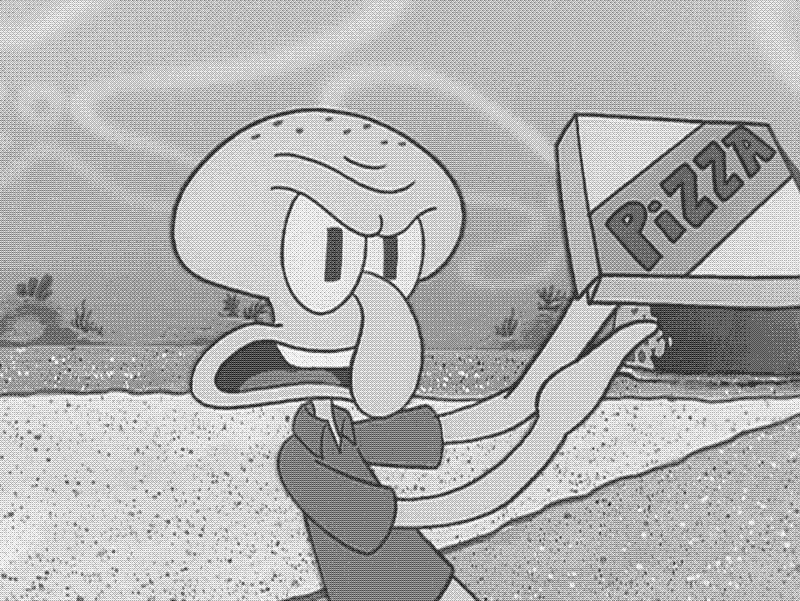
After a final gag (they were much closer to the customer’s house than they thought, so the whole trip was a waste of time), the episode ends.
This works. It shows character growth, and depicts Squidward as a character more complex than at the start of the episode. He’s transcending his spite and frustration, to stand up for someone innocent.
None of this is deep, but it’s character growth as presented through narrative. It’s kinship and warmth shown between two characters that couldn’t be more different, in a short character-driven narrative that fits within ten minutes.
The difficulty with the format of sitcoms is of course that, in a sense, the characters must never change. If they grew, they’d lose their original archetype, to a degree that the character dynamics they exist to facilitate stop working.
Take: I would be fine with that. Shows should end. The same archetypes should be interpreted and re-interpreted in other shows, and from other angles. Kill the Simpsons, etc.
In the same sense in which we should grow as people, it’s fine if narratives go somewhere. Do not flanderize yourself, and don’t clap for another twenty seasons of the same characters acting out the same jokes you have already seen multiple times over.
If you've made it this far, consider signing up for e-mail notifications, following along on Substack, or adding this blog to your RSS reader.
-
Spot one is Band Geeks, of course. ↩︎
-
You head to the factory for another shift, then come home in the evening and get another piece of dialogue from your husband, wife, or cat. Spread this out across twenty years and you discover that you’re going to get a divorce. That’s basically what it’s like. It’s repetitive, and an early conversation could’ve saved everyone a lot of time. (You may be able to tell that I thought Hades was too long-winded. I didn’t like it very much, mostly due to the expectations set by e.g. Transistor.) ↩︎
-
Many of Hades’ characters (~all Greek gods) are similarly flat, or have no meaningful dialogue beyond making puns. Part of this is just because Hades has a lot of characters, and (due to the roguelite format) is limited in the type of story it can tell. You have to cut it some slack for innovating. ↩︎