tl;dr: No practical implications. Why not? Because human mathematicians spent decades pricing in all practical implications. This will not be the case for future research. Future research will have practical implications.
If you’re reading this you’ve probably already heard the news: Levent Alpöge + Claude are claiming a proof of the Riemann Hypothesis. Lean formalized, but even compiling the whole thing apparently takes a few hours. Understanding it will take longer.
Now, let’s assume the result holds up.
Friends of mine are confused, and unsure what any of this even means.
But mond, they say, what are the implications? What does any of this shit mean? Why care?

The Riemann Hypothesis is one of the Millennium Prize Problems, and one of the most famous mathematical conjectures in history. It’s a big deal. It’s like a physics result saying something exciting about quantum gravity, or putting a man into orbit for the very first time.
The ELI5 is that the Riemann Hypothesis states that the distribution of the prime numbers is as regular as possible.
Basically, a pattern in number theory is that as you walk up the number line, prime numbers seem to show up “randomly”. You can’t predict the next one. At the same time, they are evenly distributed, so there are no weird gaps or lumps. The Riemann Hypothesis is a formalization of this.
Do not try to understand it on any deeper level unless you have a math degree, it’s not really worth it. Watch the 3Blue1Brown video on the Riemann Zeta function. If you want to be nerd-sniped after that, look at this paper for a simple elementary statement that’s equivalent to the Riemann Hypothesis.
but mond what are the practical implications?
There are none!
No, seriously. There is no practical impact of a proof of the Riemann Hypothesis on your daily life. Because it’s about prime numbers, the Riemann Hypothesis does have implications for the field of cryptography, but they are minor. It formalizes a statement that everyone already assumed to be true.
Consider the hypothetical: Imagine you were to develop an algorithm that broke cryptography (this would fundamentally reshape all of society), but which only works if the Riemann Hypothesis is true.
You can always just run the algorithm! Either you manage to decrypt my encrypted hard drive, or you don’t.
In other words, you can just assume that the Riemann Hypothesis is true. The Riemann Hypothesis doesn’t tell you “how to do X”, it tells you that the prime numbers are evenly distributed. It irons out, formalizes a few details.
This type of stuff is normal.
For example, we have no idea whether all the modern encryption that we use is “truly safe”. We don’t have a proof. Society rests on this assumption. This is, on some level, what P vs. NP is about. We cross our fingers and hope that it works.
Some proofs could show us “a new way of doing something”. P vs. NP is of this type. A proof of
P = NP could break all modern encryption. The Riemann Hypothesis is not of this type, it asks
whether a pattern is regular (we assume it is). The impact could still be there, but mathematicians have
done decades of pricing in all possible future worlds, so we can largely rule it out.
ok but why do we care?
This says something about AI capabilities.
“Solving one of the greatest unsolved problems in any academic field” is a massive deal, and demonstrates how AI systems are improving at a rapid, exponential rate.
Please understand that, say, a year ago or so, people had timelines such as “AI assistance may be able to prove a result like the RH by 2050”. Tao, 2025: “Problems like the Riemann hypothesis, those are so far out of reach”. A year prior AI was barely capable of doing basic mathematics.
In other words, the world of mathematics will never be the same. Mathematics is what drives computer science, physics, and eventually robotics. An AI capable of solving one of the greatest unsolved intellectual problems can do a lot more than that, including the development of algorithms capable of steering arbitrary robots and drones autonomously.
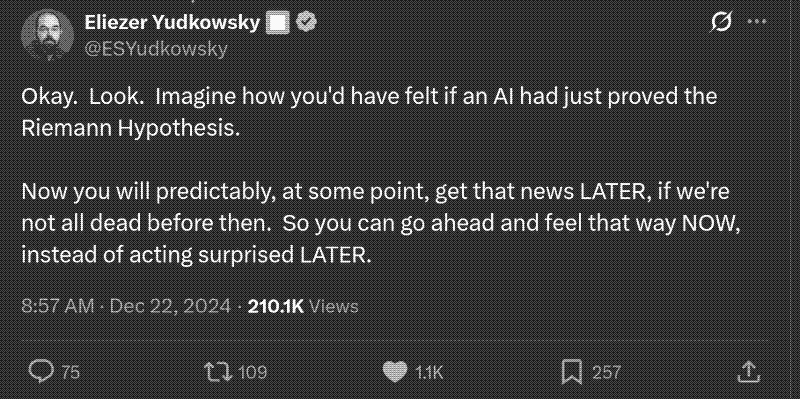
You should consider panicking a little bit, and asking yourself what this means. Understand that even if “the problem is capitalism”, this does not change that you live in a capitalist society. Accept that Eliezer Yudkowsky may have been right all along. Listen to Daniel Litt.
Then, stop panicking and take measured, principled steps. Relax. Take a few deep breaths. Express your delicate and beautiful soul. This is the time.
wait, but what will happen next?
You simply must understand that
The only reason why we know that a proof of the Riemann Hypothesis has no practical impact is because mathematicians spent decades building on top of it, and analyzing all future outcomes.
This will not be the case for all future AI research.
Right now AI research, as far as mathematics is concerned, is still in the realm of “picking off famous open problems”. It’s fame-seeking, racing. It’s aura-farming. It’s proving to the world that AI is the real deal.
Because it is attacking problems that are understood and theoretical, the outcome is already priced in.
What you should be scared of is the future world in which AI systems will be thrown at novel problems, and practical problems.
The world in which AI research will release sudden, mind-bending results that have implications which human society is not prepared for, since everything about them is novel.
Current research happens at the frontier of what humans have already been trying to understand for decades. Future research happens in the dark realm where humans have not set foot. Where opinionated AI steers the theory-building.
This could be novel methods for breaking encryption, in some form or another. It could involve novel quantum algorithms and results. It could be results in theoretical physics. It could be novel results in control theory and robotics, or micro-scale engineering, or chip design.
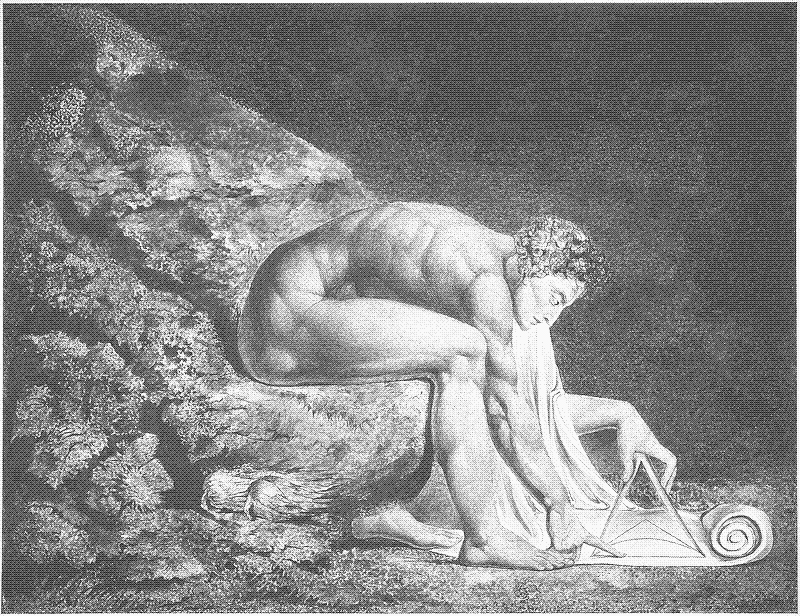
It may take weeks for human mathematicians to understand “how” the new proof works. As everything accelerates, human society may be stuck in an eternal state of “catching up”, with very little control over the boundary of research moving ahead of us.
In that world, broken encryption, novel engineering methods, etc. will force humanity to use more artificial intelligence to smooth out the impact AI is already causing. This is what’s already happening in software engineering: Artificial intelligence is used to discover vulnerabilities in all critical software.
Human maintainers end up overwhelmed with tickets, CVEs, critical flaws, and resort to AI tooling to resolve them.
Control is handed off, one field at a time, and the resulting system escapes the horizon of human understanding. The world changes. Power transfers. First slowly, then all at once.
If you've made it this far, consider signing up for e-mail notifications, following along on Substack, or adding this blog to your RSS reader.