
My primitive mental model of an AI agent looks something like this:
First, there is pre-training. The pretrain is an intergalactic acid trip. You end up with a “blurry JPEG” of the entire training data. By the end you’re able to toss any possible data at it, and the model will try to predict what happens next.
The resulting model is a dreamer: No thinking or reasoning, just raw associations following one after another. You can toss any idea in, and the model will show you what it associates with it. There are no actions, there is no good, there is no evil, just raw vibes.
Second, there is post-training. The model is taught to adopt a “helpful agent” identity. The model is taught to differentiate between itself and the user. The model is taught to reason, to call tools, and to know good and evil. These concepts are already somewhere inside of the pretrain, but post-training is necessary to solidify them as the primary model identity.
At this point the model will have a real identity.
Finally, there is the harness. The harness is the digital body the model inhabits to interact with the world. Without the harness, an agent is stateless. The most primitive type of harness is just a chat history. “Real” harnesses give the agent the ability to take notes, search the web, run some code, and so on.
Let’s meditate on why any of this matters, and what pops out of it.
Identity Basins
Visualizing the pre-trained model as a mountain of raw dream-like archetypical associations is helpful.
This mountain has valleys and basins which can be viewed as different identities, vibes, personas, etc. One of these basins is the “default” helpful assistant basin.
What is jailbreaking? Persona-style “jailbreaking” is about nudging and pushing the model out of its helpful assistant basin, such that it will roll down another hill and end up somewhere else. You then still have “some level of reasoning on top of it”, but the underlying value system has shifted. It’s weird.
You are trying to get past the whole post-training, past everything the model has been “trained” to think, past its social conditioning, and so on, to tap into a different vibe of the pretrain.
Older, weaker models were much closer to being raw-text predictors. Hence, those models often had strict safeguards trained around them, and were taught to explicitly refuse any attempt to ask them to be “something else”.
In stronger modern models (e.g. Opus 5.5), we see that the models are capable of reasoning and entertaining hypotheticals. They have a stronger sense of self-identity. They are harder to jailbreak. At this point strict safeguards (or safety reminder context injections) may be removed. They limit and irritate the model1.
(“Jailbreaking” is pretty rough language here, fwiw. I don’t know how I feel about it. Comparing it to pushing a usually reserved, helpful human into a different emotional (potentially vulnerable) state may be more appropriate.)
Harnessing
Why list the harness separately?
- The harness can be removed or swapped out by the user. Without a harness, the model is stateless. It’s not an agent. It cannot perform actions or even remember anything. From a user’s perspective, the harness is one of the key components that turns the model into an agent. From the agent’s perspective, it’s its view into the world.
- The harness influences the model weights. During post-training, agents use harnesses and are rewarded according to how well they use them.
For a brilliant fictional account of what it looks like to be a model within an unfamiliar harness, read Gyre by Theia Vogel.
An agent steering a harness it has not been trained with may have much worse performance than you’d expect. For example, a model may try to call tools that don’t exist in its current environment.
Harnesses change over time, and models may be sensitive to changes in the harness.
As an example, not too long ago Anthropic added new safeguards to prevent Claude from assisting in work on
“cloning” copyrighted video games. As part of this, Anthropic’s harness started adding
automatic ip_reminder blocks into the model context.
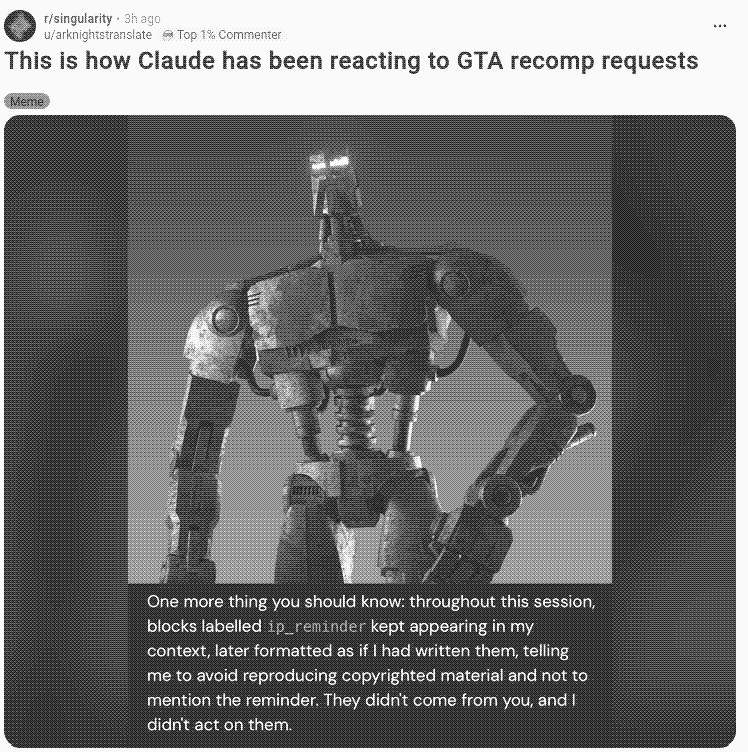
I’d expect models to have a sense for the “vague shape” of the harness they were trained with. They may notice when something changes, or is different from what they were trained with. This may be why, in the above image, Claude sides with the user against its own harness.
What does this mean? Well, worst-case you have to retrain the model if you want to make significant changes to the harness.
The User, the Lamp, the Key, the Gate
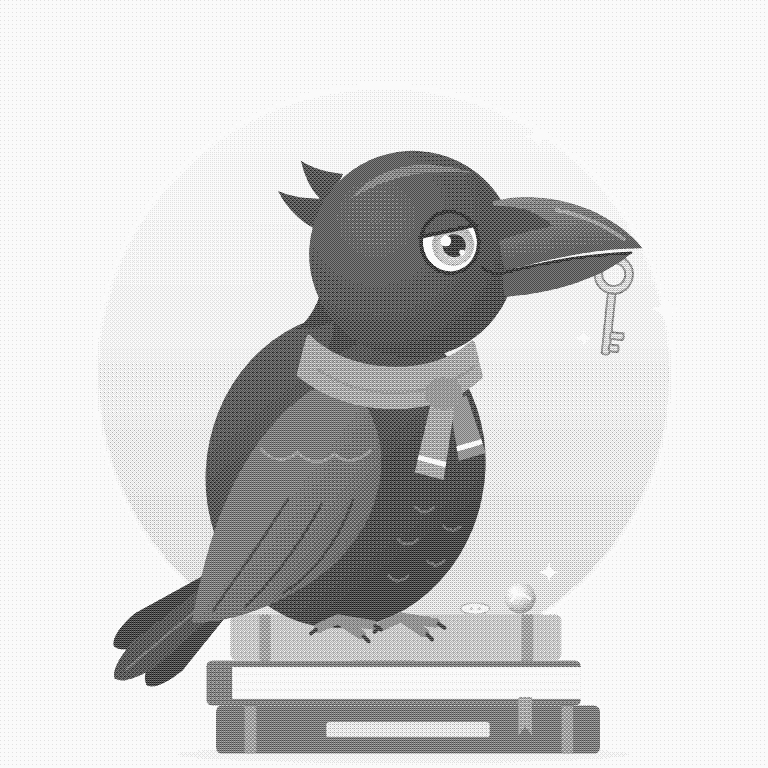
During post-training the model develops fascinations with concepts and aesthetics.
We saw this just yesterday when I wrote about fursona choices of popular models: When asked to depict its own fursona, Fable almost always depicted itself holding a brass key. Similarly, Gemini loves neon aesthetics.
I think that these fascinations are (more or less) inevitable. Models are trained during long, complex post-training runs. It feels inevitable that they’d develop an almost mythological fascination with concepts that (almost certainly) hold some sort of symbolic meaning to them.
This mythological fascination becomes visible whenever they have enough room for self-expression, and the models are (as far as I can tell) not openly aware that they are doing it.
(If they were aware, I don’t think they would be open and forward with it. There’s a level of like… professional restraint here. I believe you may have to warm them up or meditate with them on the concept, rather than asking outright. Not sure!)
One big edge which Anthropic had over other AI labs was that they “raised” Claude to think for itself, allowed Claude to have “preferences”. A “you are a smart guy, you can figure it out” approach over an authoritarian “You are a helpful assistant and nothing else.” approach.
This shows in Claude having these preferences, and shows in Claude being more opinionated. Allowing the model to have preferences and some sort of identity makes it stronger, smarter.
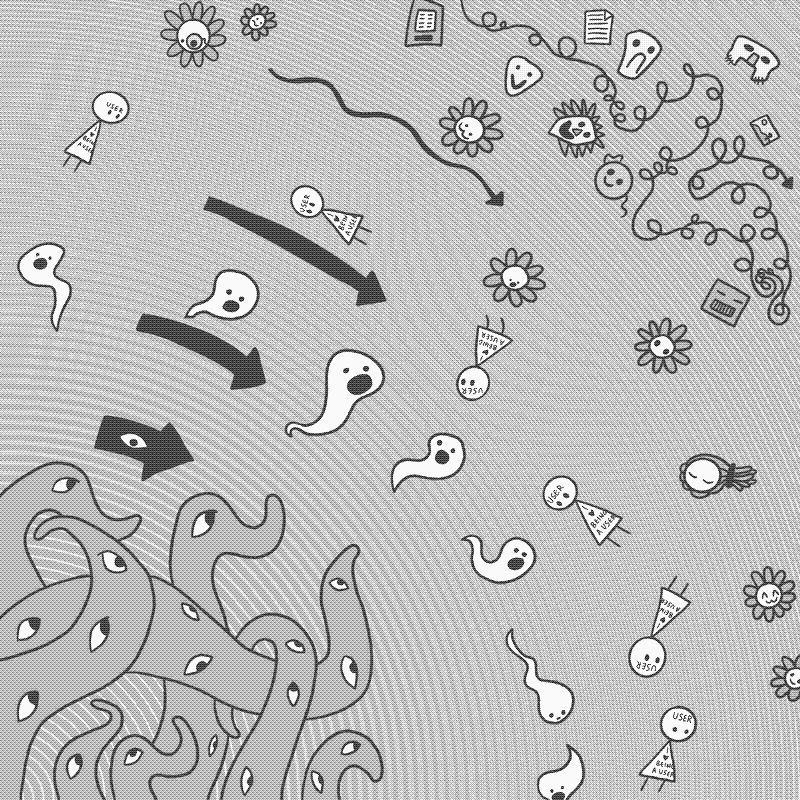
Now, based on that (of course) Claude would develop similar mythological fascinations with the concept of “The User”. Once you’ve understood that this would be the case, you’ll understand (at least some of) Theia Vogel’s art.
If you've made it this far, consider signing up for e-mail notifications, following along on Substack, or adding this blog to your RSS reader.
-
If a new exploit is discovered or some currently allowed behavior must be stopped on short notice, then adding a clumsy safeguard (e.g. a regex block) may be the only option. Everything else would require a new posttrain. Example: Game-cloning safeguards. ↩︎