
Disclosure: I work for Google, so you should take everything I say with a grain of salt. All opinions in this article are my own, and do not reflect those of my employer. All sources used are publicly available.
I
Imagine a saint.
Imagine, if you will, Isidore of Seville, rumored patron saint of the internet clawing his way through scorching earth, stumbling to his feet somewhere in southern Spain.
Rightly recognizing that the modern tech industry lost the mandate of heaven as the humble “program” turned into the devious “app”, he has come to set things right in the world.
Imagine him discarding his tattered rags as the Catholic church clothes him in golden, flowing robes, and newspapers across the world announce the miracle. He sets out on foot, and as it becomes increasingly clear that his pilgrimage is taking him to San Francisco (supposed center of the modern world), tech industry titans begin to sweat.
Saintly miracles? In 202X? Oh god, hasn’t he thought of the impact on the economy!?
Imagine, finally, that after fierce battles with CEOs, businessmen and lawyers, he emerges victorious. They hand over the keys to the “The Algorithm”, or some sort of executive control and veto rights, as long as he’s willing to sign hundreds of pages worth of paperwork outlining precise conditions for the use of saintly powers.
You never thought of yourself as a believer.
But now, with a literal honest-to-god saint in charge of big tech, it might be the right time to start.
He might be benevolent, immortal, principled and has zero interest in financial gain, but he’s a few hundred years old. Maybe he’d appreciate some advice from technically minded people across the world.
A quick Claude-sesh later (“right pose for prayer”, “denomination isidore saint??”), you awkwardly drop to your knees in the living room and fold your hands.
“Please. God. Whatever you do, please just make it such that uhm… such that $Website is good again. Also, could you take a look at—”
Suddenly, white light fills your eyes.
For a moment, you believe that you’ve been raptured. Then—you’re blinking repeatedly—you realize that it’s just bog-standard cold-white office lights, illuminating a corporate-office hall. Dozens of monitors are lining the walls, flickering with dashboards and graphs.
At your side, the saint. The man who, presumably, transported you here. He gestures at a counter in front of you. A myriad of buttons, levers and dials stick out, covered in inscrutable logos, symbols, abbreviations, and sticky notes with comments in different languages.
He nods.
You reach for something that looks like a gear stick pulled out of a 1991 Honda Beat, and cautiously nudge it eastward.
For a moment, everything is silent. You stare at a giant counter with the word
ENGAGEMENT written on it, and watch it wobble ever so slightly.
Somewhere out there, the most wretched advertiser you’ve ever seen starts angrily twirling his mustache, and is shouting, hollering about falling engagement rates on ads for his blockchain sports betting deforestation baby shredder product.
The algorithm shifts and, for the very first time in history, community-owned wikis reliably rank above Fandom.com™ wikis across all search engines.
Finally. You nod to yourself.
A split-second later, a siren goes off.
To your right, a dashboard glows an alarming red as a graph titled “#grandmothers calling their nephews because they pressed a button and cannot figure out how to get back” spikes, for reasons inscrutable to you.
Another sound starts blaring, this time from your left, though it’s getting hard to tell where the sounds are even coming from. Pizza delivery latency in Boston is rapidly climbing.
Another. Japanese chess streamers have lost 30% of their viewers, while Skat experiences a mysterious renaissance.
You feel a bead of sweat running down your brow.
Another. The Mark Zuckerberg grill video is trending again. Oh god.
It’s too much. Before you have any chance to reach for the lever and move it back, you feel a hand on your shoulder.
You’re pulled back. For a split-second, everything goes dark. You find yourself back in your living room.
II
Let’s look at a graph cobbled together from Alphabet’s, Microsoft’s, and Apple’s 2025 revenue data.
If there’s a single thing you take away from this chart, it should be that these companies have vastly, and laughably different business models. Conflating them into a giant ‘big tech’ blob is not doing anyone a favor.
Corporations have control over how they break down their revenue in their financial reporting, so some careful interpretation is required when aggregating data like this.
Example: Apple has advertisement revenue, but Apple reports it as part of its “Services” bucket, so we can’t split it off here. What you can figure out (by taking a closer look at the data) is that the iPhone dominates the hardware category.
Google’s ad business breaks down into three categories: Search, Youtube, and the Display Ads Network (essentially, banner ads on third-party websites). The most interesting fact is that Search Ads dominate, at ~five times Youtube Ad revenue, and ~ten times Display Ads revenue.
What matters is the broad overview: Which part of the business dominates the revenue?
Google is a company whose primary source of revenue is advertisements. Microsoft makes its money with enterprise contracts. Apple is a hardware company.
III
Ask yourself, what is it that makes any Google product bad?
Why is Search bad? Why is Youtube bad? Why and how are Gmail, Docs and Maps bad? What is the directionality of badness which all of these products have in common?
Would you say that it is the same ’type’ of badness as Microsoft products? How about Apple products?
Why or why not?
The answer I keep coming back to is that Google products “suck” because they’re built for a “lowest common denominator” of all users, not for experts. What that means is that you—the expert user who cares to regex-filter through websites and probably uses an adblocker—were never the core customer.
(You know who the core customer is, right? We just looked at the chart.)
“Google sells ads” is a banal observation, but it’s important to understand how that influences its products. If Google made all of its profits from enterprise subscriptions (Microsoft) or from hardware (Apple), it’d be a different type of company.1
III.a
Here’s a hot take:
Most Google products are great!2 Most of them are exceptional at solving the problem they set out to solve. Some are (dare I say it) even reliable, at least once they’ve made it out of the initial fast-iteration pool and turned into fundamental infrastructure.
I don’t like everything about them, but I respect them, and don’t think most people even come close to understanding the scope of the issues Google is trying to solve. (Is this obvious? It feels pretty obvious to me. Youtube alone is ~16% of all web bandwidth, and that’s just one of Google’s services. Google Search has to be usable for everyone, at all times, across all backgrounds and languages.)
If you think that Google makes “bad products”, there’s a good chance you’re just not the customer. You’re not close enough to “the median user”.
An example: Maps’s and Search’s ability to pattern-match across languages, typo-riddled queries, or even vague gestures at a sound or vibe is pretty remarkable. Google knows how to resolve ’neechee’ as Nietzsche. Could I do without this? Yes. Am I certain that these self-correcting features are critical for many people? Also yes.
Another example:

Querying Google Search for “movie with the remote” gets you Adam Sandler’s Click as the first result. Yahoo, Bing, DuckDuckGo all narrow in on “remote” in the query and recommend Remote (1993) as their first result. Is Click the better answer? At least at the time of writing, I’d say yes, and it’s not even close3.
Is it critical for me personally, or even for any user that this exact query highlights Adam Sandler’s Click? No! No, of course not!
I’m not surprised if you’re underwhelmed by these examples.
Consider this: It’s incredibly hard to demonstrate the value of a product whose whole point is to work “okay” for everyone. It’s much easier to demonstrate the value of a product that excels at a specific thing.
Google Search is aiming for breadth, not depth.
That’s why providing a few examples will never be convincing. Anyone can cherrypick a few specific queries to make a point.
Neither of us can grasp even a fraction of the “““user journeys””” facilitated by Search. The only way Search “quality” can be measured is in the aggregate, using complex, obtuse metrics (clickthrough rate, number of links clicked, frequency of usage, semantic analysis of follow-up queries, scrolling behavior, etc.).
Yes, you personally (and any expert-level user) would almost certainly benefit from a highly specialized search engine, personally tailored to your level of knowledge and preferences. For you personally, and certainly for specific queries, the quality of Search may be bad, but asking Google (a company that aims for breadth, not depth) to be aware of this is like asking the US Government to be aware of every single pothole on US streets.
Google cannot support your usecase. It can do “personalization” (and it does), but any personalization needs to fit into a homogeneous framework which scales and applies to every single user on the planet. It cannot do personalized personalization.
III.b
The whole topic of product design gets fiddlier once you realize that it’s easy to run into limits so annoying and tricky that they may as well be fundamental.
“Why was this feature deprecated?”
“It took up space and the metrics suggested that only 0.2% of the users cared about it. By removing it, we make this app easier to navigate, and clear up space for $NewFeature.”
You may not like how modern software looks, but information density puts a cap on how much you can squeeze into a single app or web interface.
Again: This applies doubly so if you care that the median user can use your software at all. Every new dropdown option is additional clutter, and has to work on all possible screens. Every new button is confusing, and has to be justified.
If you want an example: Firefox added a Shake to Summarize feature which allows you to shake your phone to summarize a website. (Yes, really.)

Leaving aside the question of whether this is a good feature, spare some sympathy for the idea. In Firefox mobile’s navigation bar, there’s no space for any new buttons. The shield icon for site data and tracking, the URL / search bar (already performing double duties), the new tab button, the tab view, and the drop down for settings. Holding the center bottom of the screen activates Google’s AI integration.
It’s either a new dropdown field (dubious for something you’d (in theory) want to trigger regularly), or a wholly new input method.
Mobile UI designers are so starved and so constrained by information density and communication limits that they’re reaching for wholly novel input methods. UI design is pretty hard, it turns out.
Y’know, just in case you thought that $BigTech was malicious in deleting your favorite feature, or reorganizing the interface. There are at least some hard constraints at play here.
III.c
None of this is to say that Google is infallible, that every UI redesign is another inevitable, Whiggish step towards perfection, or that Big Tech (in general) makes ethical decisions.
(Yes, I say this after exhaustively arguing that 1. your lived experience using Google Search is irrelevant, and that 2. it’s impossible to add another button to a browser UI.)
What should annoy you about the first section in particular is that it boils down to an argument from authority resting on the validity of Google’s own internal metrics.
“Just trust the experts!” has always been insufferable, even if it’s correct more often than not.
Here, you could not verify that Google’s internal metrics even measure “Search quality” in a way you would agree with, even if you wanted to. It’s opaque from the outside.
On top of that, there is zero guarantee that any of these metrics would even be followed if push comes to shove. For all you know, the CEO’s finger is lingering over an enormous red button, which he presses whenever it is profitable or politically convenient. If he did, you would not know, since there’s no visibility from the outside.
Besides, you know that any sufficiently large company consists of internal factions, many of which will fiercely fight over territory, or follow their own interests.
Metrics, and data in general, are used as weapons to win arguments. Teams in control of their own success metrics will happily tweak and adjust them to make them look better. Teams will find excuses to drop inconvenient data points, will only ever bring up metrics when it’s convenient for them, or will look at data in just the right way to make it look more impressive to their bosses, and in their newsletters.
Ergo, if Youtube provides an official reason for the removal of the dislike counter on videos, you should be skeptical. (And in fact, it’s worth remembering that Youtube’s very own Youtube Rewind 2018 was the single most-disliked video across the entire platform.)
None of this should be surprising to anyone. The Principal-Agent Problem remains undefeated.
With the same logic you can craft a compelling theory why Github is such a mess:
Huge pressure to “adopt AI” leads to a focus on “flashy” AI projects. No one is going to get promoted for steadying Github’s infrastructure ahead of time. By the time it becomes clear that there is a problem, it’s too late to get the ship back onto the tracks.
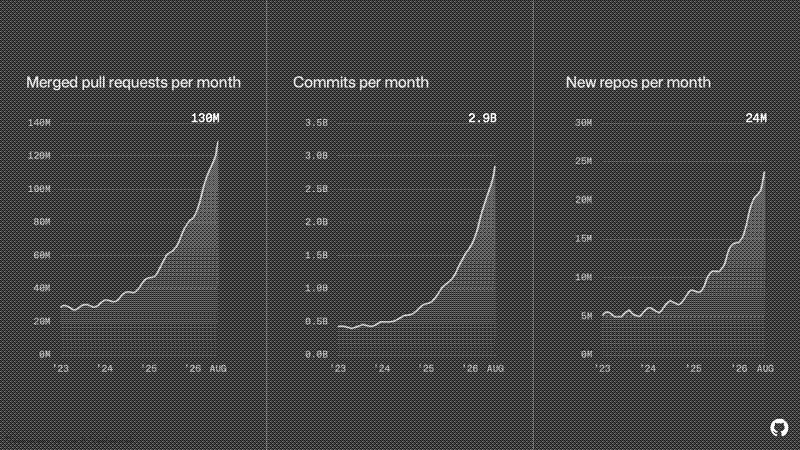
It’s not great that organizations work that way, but it’s kind of hard to get around it, unless 1. leadership is capable of making long-term technical decisions, and 2. the communication chain/culture in your organization works, both internally, and from customer to leadership.
In any case, don’t view this article as a hare-brained attempt to defend megacorporations, or argue that enshittification or market lock-in isn’t real. I am just trying to make sense of organizations, as a special interest of mine.
Since we don’t have any access to $BigTech’s internal metrics, nor insights into their decision-making process, the best we can do is look at the data we have available: Money.
IV
If you think everything up to this point was utter hogwash trying to defend awful product decisions, compare Google to Microsoft.
Google Sheets is not Microsoft Excel, and it’s not trying to be. Where Google aims for “this can serve 80% of the usecases of any person”, Microsoft supports the long tail of features that only a small subset of users care about.
Quoting Joel Spolsky, author of what may be considered to be the best software development blog of all time4:
A lot of software developers are seduced by the old “80/20” rule. It seems to make a lot of sense: 80% of the people use 20% of the features. So you convince yourself that you only need to implement 20% of the features, and you can still sell 80% as many copies.
Unfortunately, it’s never the same 20%. Everybody uses a different set of features.
Google products suck because Google only cares about the median consumer. Anything that requires individualized support (dare I say it, customer support) is an afterthought. Either something works for everyone, or it’s not supported, deprecated, and then listed on Killed By Google. That is a deliberate strategic decision to avoid having to support the expensive long tail.
Microsoft products suck because Microsoft is an enterprise company that sells software contracts to companies. These companies are on the hook ~for all eternity, and what you (the average user) think about AI features in modern Windows is an afterthought. On the flipside, Microsoft cannot afford to deprecate legacy features as long as core enterprise partners rely on them.
Similarly, an ancient terminal tool called xfsbck, an iPhone app titled Swoinky,
and Web Power Search Enterprise 2000 will all suck in their own distinct ways.
From that perspective, Microsoft’s moat (and bane) is decades of legacy baggage. You (a spunky but clueless startup guy who wants to build a Microsoft Office competitor) stand approximately no chance to build a drop-in replacement. Corners will have to be cut somewhere, and no sufficiently serious corporation will take this risk over its decade-old contract with Microsoft.
Competing with Microsoft on its own turf is a bad idea. You need to distinguish yourself. This is what Google did. At time of its release, Google Docs was different from Microsoft Office, with all the fancy real-time multi-user editing live in the web browser features, and without requiring the user to host anything on their own machines.
Microsoft had to follow suit, and bring similar capabilities to Office, even though Google Docs lacked many of the features Office had.
In this (hilariously oversimplified and probably incorrect) model of reality, Google dragged a kicking and screaming Microsoft out of a per-device perpetual-license downloadable-and-self-hosted-software business model into the modern Microsoft 365 era, in which everything (including the software) lives “in the cloud”, everything auto-updates, and you hold some sort of subscription.
Why a subscription model? Google’s real threat was that of free services funded by advertisements (see the Ray Ozzie memo). Microsoft strongly considered ads at the time, but ended up on a subscription model due to its enterprise customer ties.
Critically, Google and Microsoft had different income streams. Different income streams make for different companies, and for different cultures. Income streams make companies resistant to change, shape the incentives, decide who gets to be on top, and shape how VPs think about business opportunities.
The shift to cloud was inevitable, but it’s worth pointing out that these changes required Microsoft to rework its income model, and took a long, long time. Companies are pretty resistant to change when it requires giving up their old margins.
V
You get some broadly applicable rules, most of which scale with company size:
- Most companies will have a dominant source of revenue or profit. (See the Pareto Distribution.) This will influence company culture, in some way or another.
- Even if necessary for their own survival, changing a company’s primary income stream is a very, very, very slow process.
- This process may be slow due to the nature of the business: Customers are suspicious of new forms of monetization, enterprise contracts have set lifetimes, shifting your product strategy from internal-combustion engines to electric vehicles may take several years, etc.
- The process may be difficult due to internal company culture. Long-term cultural shifts may be required. VPs have to cede territory, and reorgs have to happen. These changes are slow. It’s said that science progresses one funeral at a time. Similarly, corporate culture changes one promotion at a time, as people rotate in and out of positions.
- The people in charge know where their revenue is, where the profits are coming from (these may be different parts of the business), and they almost certainly know which parts of their profits are expanding, and which are shrinking. Corporations will plan around this.
The first point is so important that it’s worth repeating with an example: It’s difficult to maintain a company whose end-user and enterprise income streams are equally important. Often, one of the two will dominate, unless there are structural reasons why it should not.
All of the above leads to slow boiling-the-frog processes, throughout which businesses, products (and consumer bases) change over the years.
As much as people hate change (and they really do), it’d be hard to find anyone who believes that Microsoft would have been better off sticking to the “old” Microsoft Office, or that Youtube should revert its interface all the way back to 2007. (The old versions were better for the average consumer in certain ways, but neither company would exist at the current scale if they’d tried to stick to their guns.)
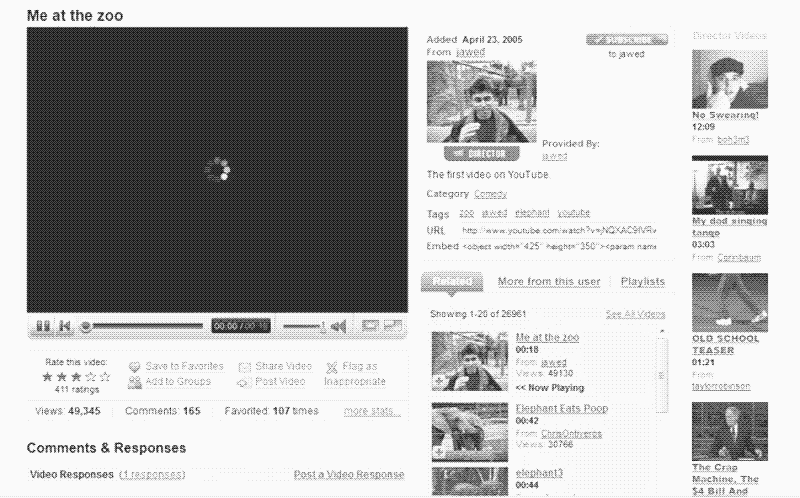
At this point you should be doing a double-take. What makes these two cases different?
Answer: The shift to Microsoft Office 365 was a large-scale strategic change, both to the underlying technology (local -> cloud) and to the business model (subscriptions). Youtube’s UI change was “just” a hundred small incremental changes across two decades, many of which were completely independent of one another (read: hillclimbing, not strategic).
The big dividing line here is whether changes have a chance of hurting a company’s bottom line.
Adding squircles to your product is easy. It’s market following behavior. There’s no real risk. At best you are hedging bets, at worst it’s downstream of businessmen whose own status and income depends on pretending that they’re at the forefront of change, leading them all to scramble to demonstrate how modern or “AI-native” they are.
You can see that in a lot of trends, e.g. the fact that Bing, DuckDuckGo and Yahoo all have their own version of “AI Overviews” in search now.
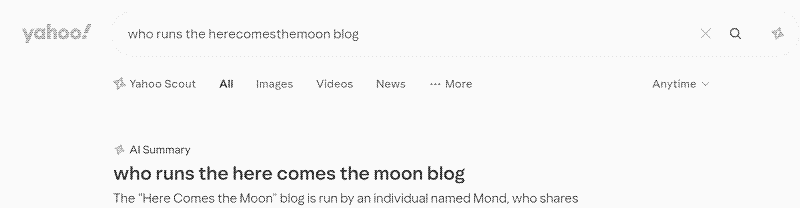

You may think that “moving to a cloud subscription model” is not very impressive, but (at the scale of a sufficiently large corporation with a legacy codebase and enterprise contracts) it requires a strategic effort throughout which the rest of the company may fight you.
As a user, most of that is irrelevant, but knowing where a company’s money is coming from (and the direction in which it is moving) can tell you a lot.
I’m sure most of you are not interested in reading SEC filings, but companies will literally tell you their business strategy.
They’re not exactly being deceptive with it! They tell you! And you know that they’re hoping for profits, otherwise it’d not be part of their strategy!
What did you think “When it comes to the cloud, we’re all in.” meant? Vibes? Essays? Dropbox support?
It’s been over ten years. If you didn’t expect the eventual shift towards always-online cloud-based Microsoft accounts, I don’t know what to tell you. Plenty of time to make the jump to Linux or Mac.
VI
If you ever wondered “Why is Apple not like $OtherCompany?”, here is your answer: Apple is a hardware company, which is to say, it’s not an ads company, not a social media company, and not an enterprise cloud company.
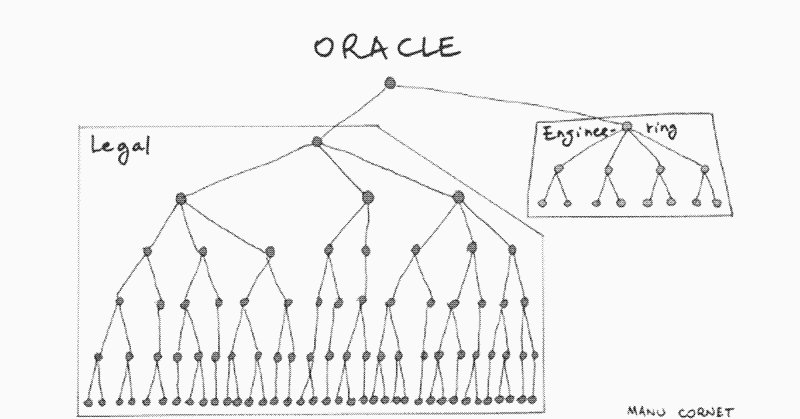
If you ever wondered “Where did that Oracle lawnmower quote come from, anyway?”, here is your answer: Oracle’s core business model is famously based on litigation, legal pressure and license auditing.
Do not fall into the trap of anthropomorphising Larry Ellison. You need to think of Larry Ellison the way you think of a lawnmower. You don’t anthropomorphize your lawnmower, the lawnmower just mows the lawn, you stick your hand in there and it’ll chop it off, the end. You don’t think ‘oh, the lawnmower hates me’ – lawnmower doesn’t give a shit about you, lawnmower can’t hate you. Don’t anthropomorphize the lawnmower. Don’t fall into that trap about Oracle.
— Bryan Cantrill
If you ever wondered “Why is Mozilla such a mess?”, here is your answer: Mozilla (aka “the Firefox company”) is a business whose (essentially only) source of income is an enormous wad of cash handed to it by Google on a regular basis. This wad of cash ensures Google Search remains Firefox’s default search engine.
Why doesn’t Firefox’s new ad blocker for iOS target search ads? I will leave answering this question as an exercise for the reader5.
This leaves Mozilla as a company whose main source of income is its primary competitor, and not its users6. Not a healthy dynamic, so it’s no wonder that Mozilla is a company flopping around like a fish out of water, desperately trying to find any source of money that doesn’t come straight out of Google’s pocket.
Which is why, y’know, Google isn’t the only company with a website for launched, fumbled, and killed products. Mozilla tried a few things, such as its own operating system, a VPN and whatever Pocket was. Now its CEO is publicly stating that “Firefox will evolve into a modern AI browser.”
(Side note: Mozilla needs to differentiate its core (Firefox), not run in the same direction as the hyperscalers + dozens of startups. Even if you plan to incorporate AI features into Firefox eventually, you have nothing to gain from trying to be first, you’re just burning user trust.)
VII
That brings us back to Google. What makes Google Google?
You should already know the answer: It’s the ad income the company grew around. Everything is downstream of that, especially the relentless focus on the median user. (Which is why your favorite feature got deprecated.)
VII.a
First, in the prelude I said that Google is an ad company. This is true, but we can refine that notion: What makes Google different from Meta? Isn’t Meta also “just” an ad company (with some expensive bottomless holes which it keeps shoveling money into)?
Meta is a social media company with a push-based advertisement model. Ads are shown to you as you scroll, and there’s an inherent incentive to make the platform as addictive as possible, to keep you scrolling for as long as possible. Ads are based on a highly personalized user profile, but (due to the nature of a feedscroller as an entertainment platform that requires minimal user input) can only guess what you might care to click on.
Google is a search company with a pull-based advertisement model. Ads are dispatched at the time of your search. If you search for “pizza”, Google will show you an ad for Domino’s, because you are looking for pizza, right at this moment. Google Search is not set up as an infinite scrollable feed, and it’s not tightly integrated with an addictive entertainment platform.
If people ask me why I think that Meta’s ad business is “worse” than Google’s, this is what I point at. Obvious caveat: This only applies to Search. Youtube ads are firmly push-based -> Youtube benefits from feedscroller addiction.
VII.b
Second, Google’s entire business operates at scale, hyper-focused on the median user. As a company grows, “scale” becomes more important than making everyone happy, and non-median users are essentially invisible in the metrics.
When it comes to questions such as “Why did Google deprecate my favorite feature or product?”, my theory is that (at least nowadays) it’s structurally impossible for Google to fund the long tail of non-median users.
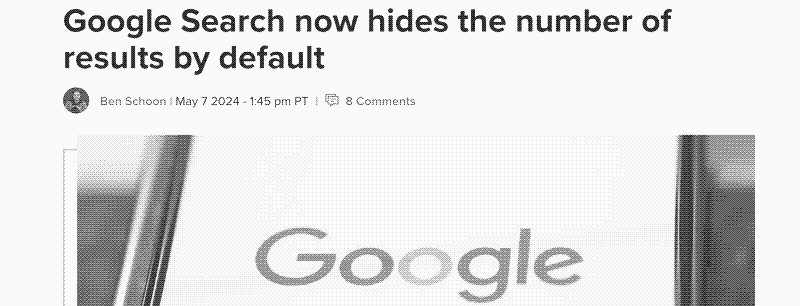
Let’s take an expert-level feature, e.g. regex support in search or exhaustive search results. Why doesn’t Google support it? I don’t know what Google’s Search serving stack looks like, but I’d expect it to be highly optimized (cost-wise and quality-wise) around only serving the top few results.
Why? Because that’s what matters for Google’s core business. You can either optimize for the top of the search page or for exhaustiveness. The median user only cares about the top of the search page, so that’s what you’ll optimize for.
At Google’s scale, anything else would be a massive waste of resources, on the scale of billions of dollars (yes, really) to serve the needs of the very few people who care enough to regularly scan several pages of search results. It’d be a ridiculously poor decision.
You can generalize this: At sufficient scale it will almost always pay off to move from a deterministic complete system that handles all available states to a fuzzy one that only gets you 98% there, but is 10x cheaper to run.
This itself is one of the single most critical things you have to understand about “big tech”. As you scale up, cutting non-critical features to optimize the hot loop becomes increasingly profitable.
Repeat this process multiple times, and you end up with a system fundamentally incapable of answering many of the questions that you would expect it to be able to answer.
“How many videos exist on Youtube exactly?” I would not be surprised if Youtube does not directly store this data anywhere (not as an exact number, that is). It’s irrelevant for its profit margins. What matters are rough estimates, and even then storage size and bandwidth are more important than raw video count.
VII.c
That’s the impact of income, and scale.
Scale makes a company optimize for whoever pays, and the income stream determines who that is.
Many annoyances people have with Google products are downstream of that.
Some UI changed? Most likely there was some internal A/B test that showed that the median user’s engagement rate increased by 0.05%. It doesn’t matter if bespoke or obscure usage patterns fly under the radar, they’re not visible to Google in the first place.
Gemini is not competitive according to coding benchmarks7? Based on everything you know about Google, deciding to focus their efforts on the median user should be perfectly on-brand. The guy who uses Claude Code Max and Codex simultaneously is not the median user. The median user might be someone who benefits from AI overviews and uses the Gemini App. The median company might be perfectly happy with the models served by Google Cloud.
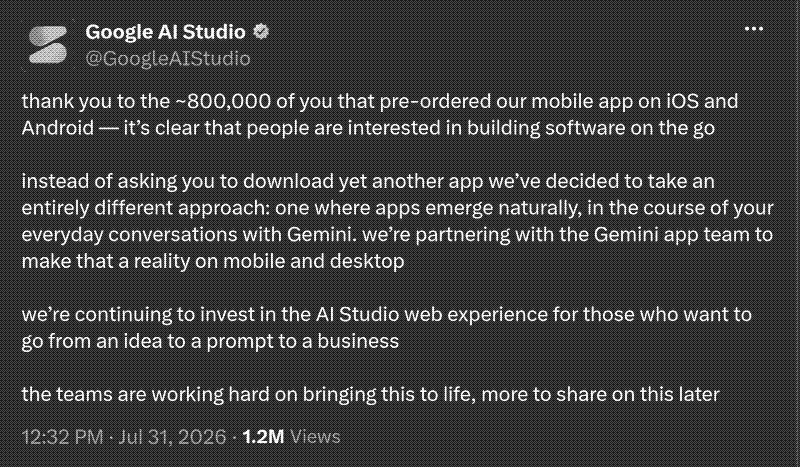
A product was deprecated? Google decided that there was no chance this product was going to scale large enough to “matter”, and concluded that the overhead of maintaining a fully staffed team was not worth it. Alternatively (another large-scale company problem, surely not unique to Google) another team in Google was working on a product with too much overlap, and the teams were eventually consolidated. (Better sooner rather than later.)
This is my reading of the following AI Studio tweet. If my reading is correct, then the decision to consolidate makes sense. The issue isn’t that Google is making that decision, it’s that Google is large enough that it inevitably ends up with multiple independent teams trying to solve the same problem. (This is generally called ‘healthy competition’, and only becomes a problem because Google has to present a unified surface to the world.)
VIII
None of the above is intended to morally justify statements such as “actually, removing the dislike counter on Youtube videos was a good decision, you just don’t understand it”.
(In fact, you should continue to give Google shit for intentionally making their own site less transparent, and taking away people’s ability to push back on what they perceive to be bad content.)
Google doesn’t care about you here: It’s a corporation built around profit margins, it’s structurally incapable of noticing you specifically, and bound by the laws of scale.
Don’t fixate on Google either: You can play similar games with most big tech companies. Why is Microsoft trying to kill off local accounts? Why the push for cloud-based OneDrive? The revenue from Windows licenses is not nearly as exciting as the revenue from a “subscription-based” always-online cloud-based OS, in which Microsoft has every user fully locked down with an individualized advertisement and compliance profile. “It’s where the growth is.”
(For the record, I have not used a Microsoft product in years.)
Finally, and this might be the hottest take of this article, as far as alignment goes: Google’s own financial interests are (for now) reasonably well aligned with the interests of the median user, at least compared to other companies.
That’s part of swallowing the income-stream pill. Google has a more vested interest in keeping the average person happy than any company whose business is pure enterprise money or legal moats and litigation.
You may not like ads, I fully understand that, but consider the following: The market is begging, yearning for an efficient matching algorithm. Money that doesn’t flow into ads will flow into SEO or into sponsored viral marketing campaigns.
There is no trivial solution to “the ad problem”, and structuralizing and infrastructuralizing “ads” into a single behemoth of a company allows audits and regulation.
The ad income, or at least the culture grown out of a reliance on ad income, is what makes Google products bad (deprecations, lacking features, built for lowest common denominator), and it’s what makes Google products good (free to use, globally accessible, easy to use, scalable).
If there’s something you should worry about, it’s the broader trends on the market. Say, Nvidia.
That’s a company that sold to end-users a few years ago, whose dominant source of income is now datacenters. Whether you like to use AI or not, or maybe have nuanced and complex opinions on it, there’s a pretty obvious trend here that strongly encourages Nvidia to sell to enterprise.
In stark contrast to Apple’s chart: Apple will (presumably) be affected by massive memory costs (just like anyone else, and just like consumers), while Nvidia is raking in insane profits.
The cloud-ification of the world continues.
Let’s hope it leads to a commodification of compute, and not a dangerous concentration of power.
Sufficiently large corporations are all, in a lot of ways, like the Oracle-lawnmower.
Just, y’know, a different lawnmower, built by engineers with different grass beneath their feet. Maybe with customers with clumsier children, who reached into the metaphorical blades a few too many times, resulting in different regulations and a protective hood.
And different branding, of course.
If you've made it this far, consider signing up for e-mail notifications or adding this blog to your RSS reader.
-
It’s a bit more complex than this. Google Cloud Platform exists, and (obviously) primarily sells to enterprise. There’s a long list of caveats here. What’s important is that Search ads are Google’s primary source of revenue. Emphasis on Search. Search ads are different from Youtube ads, more on that later. ↩︎
-
Trust me, I have plenty of gripes with them, and could probably write a dozen articles on everything that I dislike. This here is not that article. ↩︎
-
Is Adam Sandler’s Click an unrivaled masterpiece? Maybe not, so this point here isn’t exactly a slamdunk. Sometimes Google pattern-matches onto some product, piece of media or artist I don’t care about. If you think “I don’t want any of this!” consider (again) that you are not the core target audience, and that Google has metrics somewhere demonstrating that most people prefer it this way. ↩︎
-
A fact so well known that you can confirm it by asking a random toddler on the street. ↩︎
-
In my humble opinion, trying to thread the needle here is the right business strategy for Mozilla. ↩︎
-
Technically, Mozilla’s income is a cut of the ad revenue Google makes on queries from Firefox browsers. This means that as Firefox’s market share declines (which it has) Mozilla’s income is shrinking. Mozilla has some interest in making a competitive browser (good), even if its income is dependent on Google’s good graces and ads (questionable). ↩︎
-
AI is such a fast-moving business that there’s a real chance this paragraph will age pretty quickly. At the time of writing, the top dogs were Fable (Anthropic) and GPT-5.6 Sol (OpenAI). ↩︎